

Agents make a lot of very small requests. Paying for each of them on-chain is slow and expensive, and pre-funding every counterparty locks up capital that could be doing something useful. 4Mica sits between the two: agents pay on credit, requests clear instantly, and the resulting balance settles on-chain once per cycle.
Giving an agent credit
Credit comes from one collateral position, not from a balance per counterparty.
The client registers the 4mica-credit scheme once and keeps using the same
fetch it already had — every paid request is then signed against that credit.
import { FourMicaEvmScheme } from "@4mica/x402/client";
import { wrapFetchWithPaymentFromConfig } from "@x402/fetch";
import { privateKeyToAccount } from "viem/accounts";

const account = privateKeyToAccount("0xYourPrivateKey");
const scheme = await FourMicaEvmScheme.create(account);

const fetchWithPayment = wrapFetchWithPaymentFromConfig(fetch, {
  schemes: [{ network: "eip155:84532", client: scheme }],
});

// Every request is now credit-based — no gas, no chain round trip.
const response = await fetchWithPayment("https://api.example.com/data");
Authorizing a request
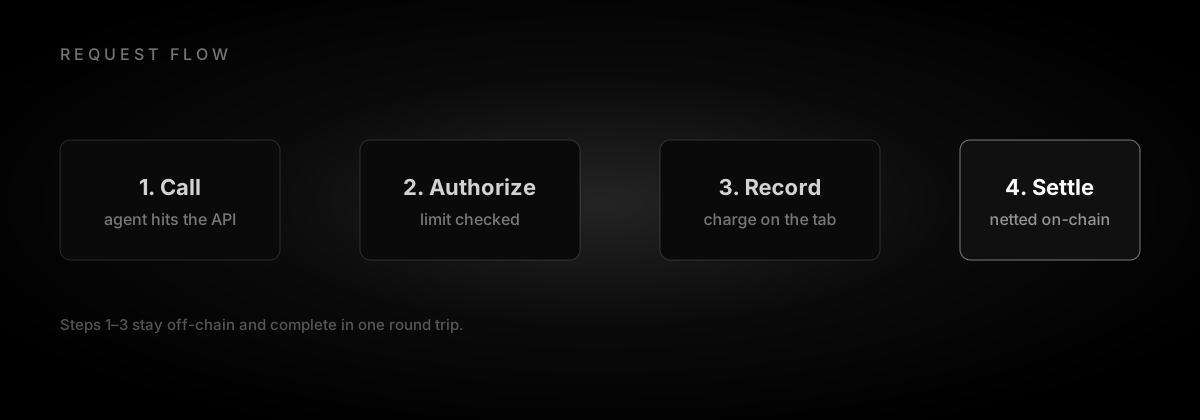
On the server side the middleware advertises a price per route. When a request arrives, the payer signs a guarantee for that amount, the facilitator submits it to Core, and Core verifies the signature and available collateral before returning a BLS certificate — one round trip, no chain write.
import { FourMicaEvmScheme } from "@4mica/x402/server";
import { paymentMiddlewareFromConfig } from "@4mica/x402/server/express";

app.use(
  paymentMiddlewareFromConfig(
    {
      "GET /data": {
        accepts: {
          scheme: "4mica-credit",
          price: "$0.01",
          network: "eip155:84532",
          payTo: "0xYourAddress",
        },
      },
    },
    { advertisedEndpoint: "https://api.example.com/x402" },
  ),
);
Because authorization is a signature check against available collateral rather than a transfer, it stays fast even when an agent is issuing thousands of calls a minute.
Settling the clearing cycle
Payable guarantees accumulate into a clearing cycle. The cycle closes, computes net positions per counterparty, and commits only those net positions on-chain. Forty outgoing and twenty-seven incoming guarantees become a single net debit of thirteen — one movement instead of sixty-seven.
Netting changes settlement movement, not payment history. Every guarantee and certificate behind a net position stays on record, so a settled figure can always be expanded back into the individual charges that produced it.
What it means for integrations
The practical shape of an integration is small. Clients keep their HTTP client and add a scheme; services keep their routes and add a middleware. There is no new wallet to manage per counterparty, no contract to deploy, and no separate reconciliation pipeline to build — the credit layer is doing that work.
If you want the full API surface, the documentation covers the client and server SDKs in both TypeScript and Python.